
Garage, lanai and shop floors across Central Florida
Epoxy Flooring in Orlando, FL
Systems sized to wet summers, hot tires and 4 p.m. glare, picked only once your slab has been tested.
- Moisture reading taken at every free on-site visit
- A written quote that lists every coat and prep step
- Surface prep explained before any grinding begins
Concrete Coatings Planned Around Orlando's Wet Season
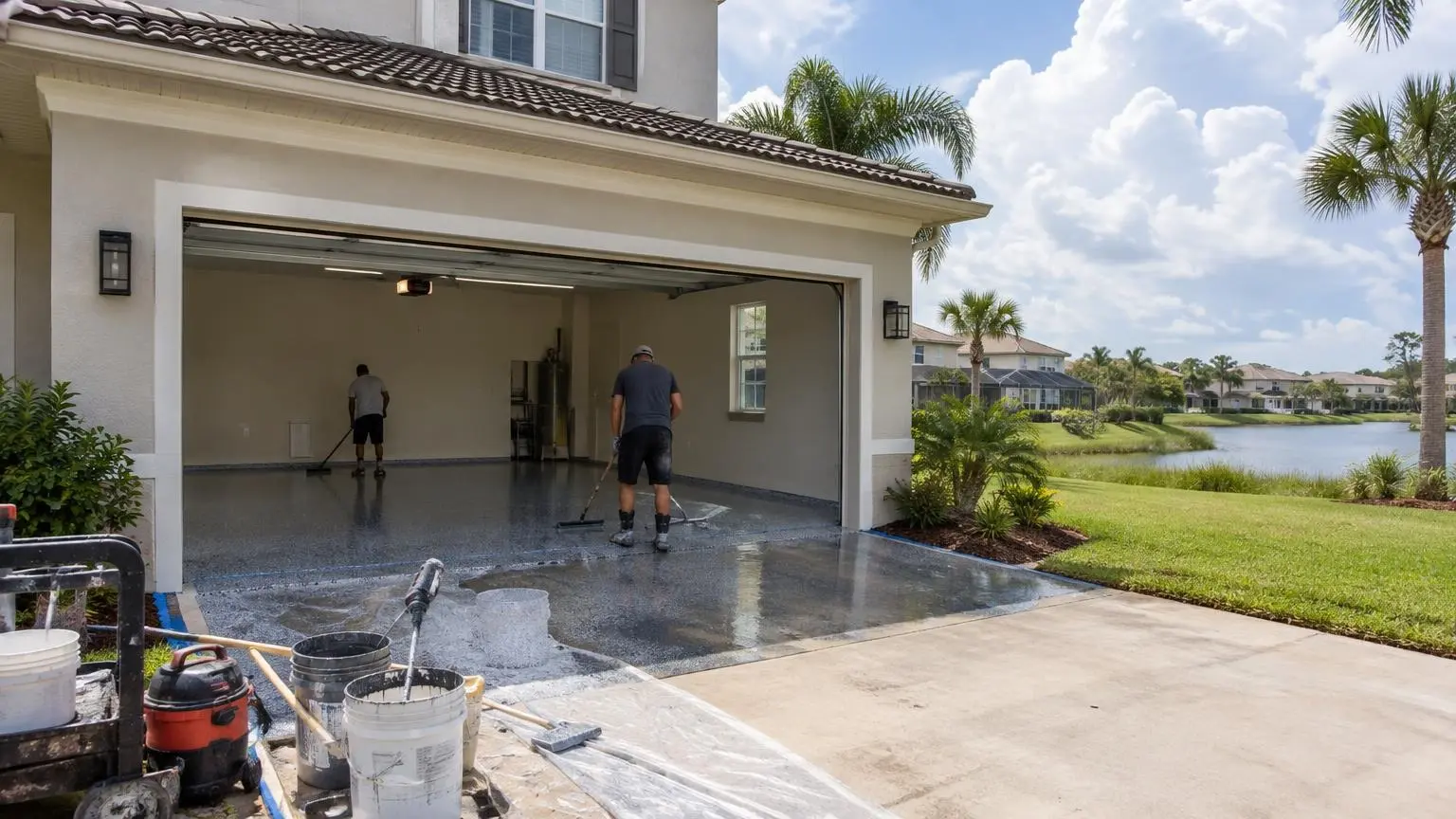
Epoxy flooring in Orlando, FL has to handle a climate that never freezes but rarely dries out. Orlando sits about 42 miles inland from the Atlantic and 77 miles from the Gulf, on flat, low ground scattered with hundreds of lakes, and the National Weather Service in Melbourne puts the median start of the local wet season on May 27. From then until about mid-October, the air is heavy, afternoon storms arrive almost daily, and concrete slabs pick up moisture from the ground below. Orlando Epoxy Flooring Pros installs epoxy floor coating, polyaspartic, flake and metallic systems with that calendar in mind, starting with a moisture reading on every slab we quote.
Why Orlando floors fail, and how to avoid it
Most coating failures we see around Orlando trace back to a few causes. None of them is cold or road salt, which is what trips up floors up north. Here the culprits are water and sun.
- Moisture vapor. Wikipedia's summary of Orlando's climate records 51.45 inches of yearly rainfall on average, with June through September carrying most of it, over about 121 days with measurable rain. Water in the soil pushes vapor up through the slab. A coating laid on top without a moisture-tolerant primer can blister and lift.
- Heat and UV. The city averages 90-degree days from early April to mid-October, and the heat index can top 110. Standard epoxy turns amber when sunlight reaches it. Wherever daylight lands, the top layer has to be polyaspartic or another sun-stable clear.
- Hot tires. Tires that have just come off a sun-baked road can soften a thin, cheap coating and peel it away. Full-thickness systems resist that. Thin store-kit paints do not.
- Poor prep. Coatings bond to open, clean concrete. Grinding is the step that makes everything else work, so we never skip it.
The slab under your garage
Orlando's homes span a long stretch of building eras. Point2Homes, drawing on 2019-2023 American Community Survey numbers, reports 1992 as the median year a home in the city was built. About 20.9% of housing went up between 2000 and 2009, and another 16.5% between 2010 and 2019. The neighborhoods ringing downtown, such as College Park, Thornton Park and Lake Eola Heights, grew out of the 1920s land boom and hold many of the city's earliest houses. Each era hands us a different floor.
- Pre-1960 bungalows and converted carports: thin slabs, years of paint, and more patching.
- 1970s to 1990s homes: settlement cracks, oil-soaked parking spots and worn sealers that must come off.
- Homes built since 2000: solid concrete with a hard, slick trowel finish that a coating will not grab until it is ground.
Lakes, limestone and flood zones
Central Florida rests on porous limestone, and the area is known for sinkholes. The 1981 Winter Park collapse, just north of downtown, is the case most people remember. Small cracks in a garage floor are usually just shrinkage, but one that keeps growing, or a slab that has tipped, belongs with an engineer before any coating crew. We give you our honest read on which it is. The City of Orlando also suggests checking its Information Locator Tool and the FEMA flood maps to see if a property sits in a Special Flood Hazard Area. For a garage that has taken on water before, we lean toward a chip floor under a gritty clear that can be hosed out and dries fast.
Choosing among epoxy flooring companies
Page one of Google for this city is crowded with chains, directories and supply stores selling DIY kits. If you are comparing epoxy flooring contractors, here are fair questions to ask any of them, us included.
- Is there a moisture test, and what changes if the number is high?
- Do you diamond grind, or acid etch?
- What is the topcoat, and is it UV stable?
- How many coats, and how thick is the finished system?
- What are the foot-traffic and parking times?
- Is everything you just told me written into the quote?
Epoxy floor installers who answer all six clearly are worth a closer look, whoever they are.
What epoxy flooring cost looks like
National guides give a starting frame. Per HomeGuide, an installed epoxy floor runs $4 to $10 per square foot and a two-car garage $1,600 to $5,800, with polyaspartic at $5 to $12 per square foot. This Old House puts crack and chip patching at $25 to $250. Where your floor lands depends on size, how much old coating has to come off, the number of repairs, and the finish you pick. Chips under a polyaspartic clear generally run higher than a single-color epoxy, and it lasts longer in a west-facing garage. A price comes in writing once we have seen the concrete, and that written price is what you pay.
Homes, rentals, HOAs and businesses
About 60.5% of Orlando's occupied housing is rented, per the same ACS summary, so we work with owners, landlords and property managers alike. A coated garage or laundry floor wipes clean between tenants and stands up to move-in traffic. Many newer neighborhoods have an HOA. Florida law (section 720.3035) limits what an association can regulate inside a structure that cannot be seen from the street, a neighbor's lot or common areas, but garages with open doors, driveways and pool areas can be another matter. Read your declaration first. Commercial floors are a big part of the local picture too, with the Orange County Convention Center, Orlando International Airport, hospitals, food processing and a research park of more than 1,025 acres all needing tough concrete floor coating.
Getting started
The simplest first step is a visit. We measure, check the slab, hear how the space gets used and show you samples. You keep a written quote to weigh against other bids, and you can take your time deciding. If the dry season suits your schedule better, from about mid-October on, we can book the install for then.
Our Services
Six coating systems, from a basic garage floor to a resurfaced pool deck. Each one starts the same way: a test, a grind and a written plan.
Epoxy Garage Floors
A ground, primed and sealed garage floor that shrugs off hot tires, oil drips and wet-season humidity.
Learn more →Flake Epoxy Coatings
Chip floors that disguise grit and scuffs, add traction and come in many color mixes.
Learn more →One-Day Polyaspartic Floors
A fast-curing polyaspartic floor coating that resists UV and lets you park again in about a day or two.
Learn more →Metallic Epoxy Floors
Swirled, pearl-like metallic epoxy floors for living spaces, offices, studios and show garages.
Learn more →Commercial Epoxy Flooring
Concrete floor coating systems for warehouses, shops, kitchens, clinics, retail floors and back-of-house areas.
Learn more →Pool Deck & Lanai Resurfacing
Cooler, grippier pool deck resurfacing and lanai coatings built for full sun, bare feet and pool water.
Learn more →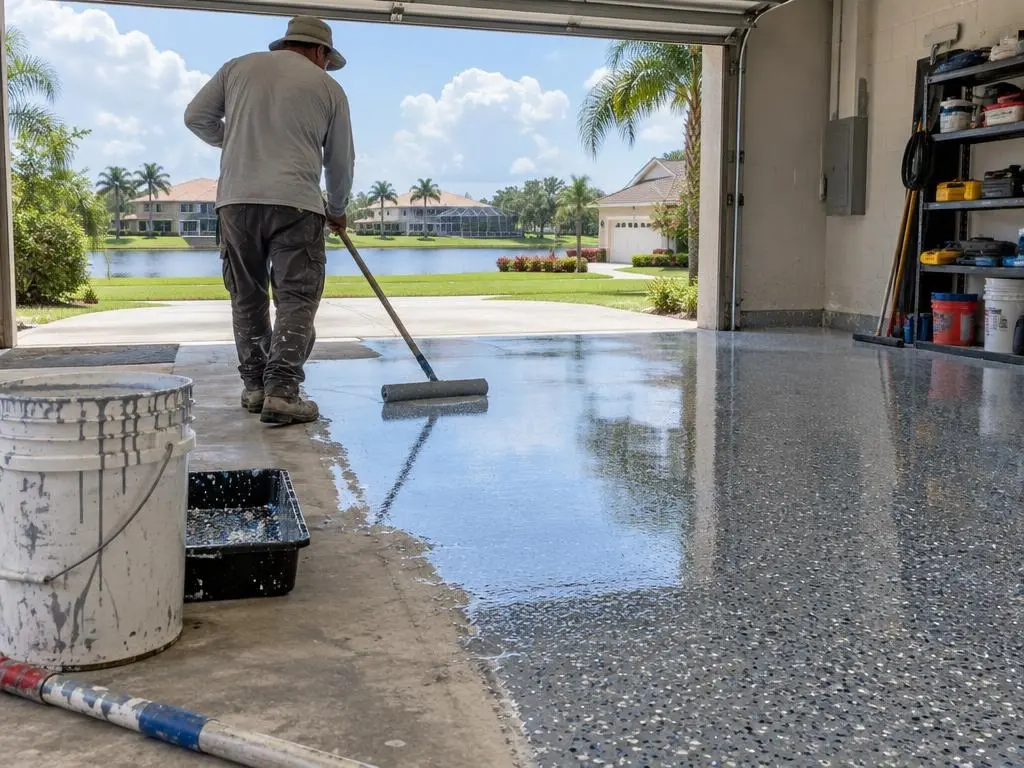
Neighborhoods and Nearby Cities on Our Route
We work inside Orlando city limits, from College Park, Baldwin Park and Thornton Park down to Lake Nona and Conway, and out into all four counties of the metro. To the west that means Winter Garden, Windermere, Ocoee, Horizon West, Doctor Phillips and Clermont. North of the city we cover Winter Park, Maitland, Apopka, Altamonte Springs, Casselberry, Longwood, Lake Mary, Sanford, Oviedo and Winter Springs. To the south we cover Belle Isle, Meadow Woods, Hunters Creek, Kissimmee, Celebration and St. Cloud. The floors change as you drive. Lakefront homes near Belle Isle and Windermere tend to need closer moisture checks. Newer subdivisions in Horizon West and Osceola County bring smooth, hard slabs that need careful grinding. North of downtown, older homes in Winter Park and Casselberry often carry decades of paint.
- Epoxy Flooring in Orlando, FL
- Epoxy Flooring in Winter Park, FL
- Epoxy Flooring in Maitland, FL
- Epoxy Flooring in Winter Garden, FL
- Epoxy Flooring in Windermere, FL
- Epoxy Flooring in Ocoee, FL
- Epoxy Flooring in Apopka, FL
- Epoxy Flooring in Altamonte Springs, FL
- Epoxy Flooring in Casselberry, FL
- Epoxy Flooring in Oviedo, FL
- Epoxy Flooring in Winter Springs, FL
- Epoxy Flooring in Sanford, FL
- Epoxy Flooring in Lake Mary, FL
- Epoxy Flooring in Longwood, FL
- Epoxy Flooring in Kissimmee, FL
- Epoxy Flooring in St. Cloud, FL
- Epoxy Flooring in Clermont, FL
- Epoxy Flooring in Lake Nona, FL
- Epoxy Flooring in Doctor Phillips, FL
- Epoxy Flooring in Celebration, FL
- Epoxy Flooring in Belle Isle, FL
- Epoxy Flooring in Conway, FL
- Epoxy Flooring in Horizon West, FL
- Epoxy Flooring in Meadow Woods, FL
- Epoxy Flooring in Hunters Creek, FL
Why Homeowners Call Orlando Epoxy Flooring Pros
We read the slab before we quote it
Every estimate includes a moisture check, because damp concrete under a coating is the most common way Central Florida floors fail.
Sun-safe finishes where light reaches
Garages with west-facing doors, lanais and pool decks get UV-stable polyaspartic topcoats, so the color does not turn amber.
Grinding, not shortcuts
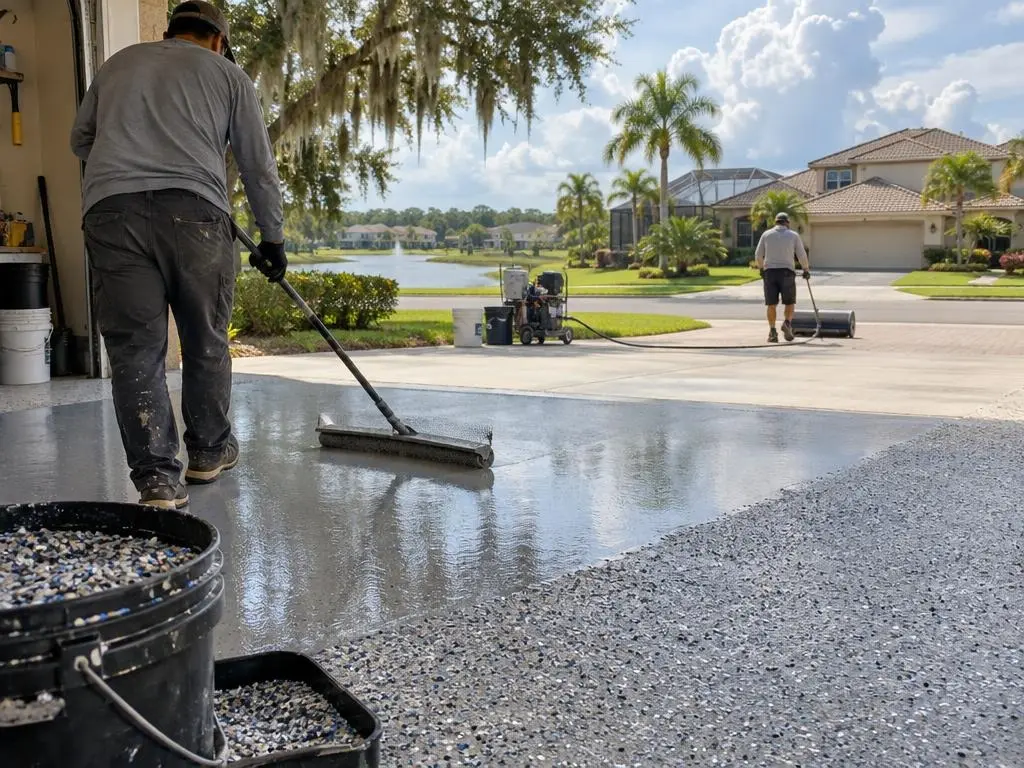
We diamond grind every floor, fill cracks and spalled joints, and vacuum the dust before the first coat goes down.
One written number
The quote spells out the system, the coats, the prep and the total. If something changes on site, we tell you before we do the extra work.
Common Questions
What is the downside of epoxy flooring in a Florida house?
Ordinary epoxy ambers when the sun hits it, can be slippery when wet without a texture additive, and needs several days before you can park on it. It also fails if laid over a damp or dirty slab. In Orlando we answer those issues with moisture testing, grinding, UV-stable topcoats and grit in the final coat.
Is it expensive to epoxy your floor around Orlando?
It costs more than paint and less than most tile. In HomeGuide's numbers, epoxy installed comes to $4 to $10 per square foot; for polyaspartic, the range is $5 to $12. Old coatings, cracks and decorative finishes push the total up. Your written estimate is the number that counts.
How much does a 20x20 epoxy floor cost?
A 20 by 20 floor is 400 square feet, about the size of a smaller two-car garage. For a garage that size, HomeGuide's range is $1,600 to $5,800 with epoxy and $2,000 to $6,900 with polyaspartic. Condition and finish decide where yours falls.
How much does a 1,500 sq ft epoxy floor cost?
Larger areas are usually priced by the square foot, so start with the per-foot ranges: HomeGuide lists $4 to $10 for epoxy, and HomeAdvisor lists commercial 100% solids systems at $12 or more. Big open floors often price lower per foot than small ones, but prep and repairs vary. We measure and quote it in writing.
Can you coat a garage floor during the rainy season?
Yes, with care. We check air and slab temperature plus humidity ahead of each coat, keep the garage closed to rain, and match the primer to the moisture number. If a storm day makes conditions wrong, we move the coat rather than force it.
Will my homeowners association need to sign off on a garage coating?
Often not, but it depends on your declaration. Florida statute 720.3035 limits association control over interior areas that cannot be seen from the street, neighbors or common areas. Driveways, pool decks and visible areas may still need approval, so check your documents. We can supply samples if they ask.
When does the car go back in after coating?
It depends on the system. HomeGuide's figures put polyaspartic at roughly 24 to 48 hours before heavy vehicles, and epoxy at as long as a week for a full cure. Your quote carries the specific times for your products.
Book a Look at Your Concrete
Tell us the town and the floor. We will come measure, test the slab and leave you a written price.